
Written by :
Published on :
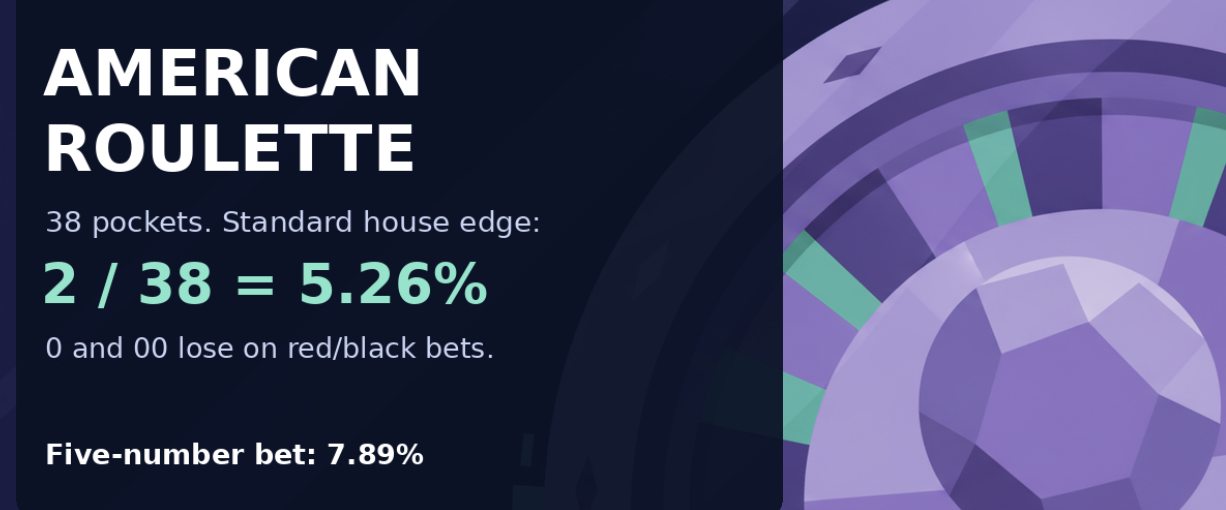
American roulette has a house edge of 5.26% on almost every bet on the table. That number comes from the wheel, not from any bet being "riskier" than another. A standard American wheel has 38 pockets: 1 through 36, plus a single zero and a double zero. The house pays out as if there were only 36 numbers. That gap between real odds and payout odds is the house edge, applying to every spin, win or lose.
It helps to see that gap worked out in numbers, not just quoted as a percentage. You can try this yourself without risking money. The free American roulette simulator lets you spin a virtual 38-pocket wheel with play money. Watch the gap between what you wager and what comes back over many spins.
Key takeaways
- American wheel: 38 pockets (1 to 36, plus 0 and 00).
- Most bets: 5.26% house edge, or about $5.26 lost per $100 wagered on average.
- One exception: the five-number bet (0, 00, 1, 2, 3) runs at 7.89%.
- The edge is a long-run average per dollar wagered; a single session can land far from it either way.
What Does "House Edge" Mean in American Roulette?
House edge is the casino's expected share of every dollar wagered, averaged over a very large number of spins. It is not a tax on your bankroll. It does not build up the longer you sit, because each spin is independent and the wheel has no memory. "The house edge is 5.26%" does not mean "I will lose 5.26% of my bankroll tonight." What happens on any given night depends on luck, with exact numbers below.
Where Does the 5.26% House Edge Come From?
Take an even-money wager like red, black, odd, even, 1 to 18, or 19 to 36. Eighteen of the 38 pockets pay that bet. Twenty lose it: 18 of the other color, plus 0 and 00. Per dollar bet, the expected result is 18/38 times plus one dollar, plus 20/38 times minus one dollar. That works out to minus 2/38, or minus 5.263%. Britannica's entry on roulette puts it plainly. On an American-style wheel, "the advantage... for the bank rises to an extra 2 parts in 38, or about 5.26 percent of all bets."
A straight-up bet on one number gives the same answer a different way. It wins 1 time in 38 and pays 35 to 1. So 1/38 times 35, plus 37/38 times minus one, also equals minus 2/38.
One way to see this: cover the whole wheel, staking $1 on each of the 38 numbers. Exactly one wins every spin, returning $36 (the 35 to 1 payout plus your dollar back). That is a total stake of $38, down $2 on $38 wagered, the same 2/38 edge as cash. Every standard American bet, straight, split, street, corner, line, column, dozen, and even money, comes out to the same 5.26%. Each pays off as if the wheel had only 36 pockets.
Why Does the Five-Number Bet Cost 7.89%?
One bet breaks that pattern. The five-number bet covers 0, 00, 1, 2, and 3 in a single wager. It pays 6 to 1. The Massachusetts Gaming Commission's roulette rules list "First Five Numbers" at 6 to 1 payout odds for licensed casinos.
This bet wins with probability 5/38, about 13.2%. A fair net payout for that probability would be 33 to 5, or 6.6 to 1. The actual payout is only 6 to 1. That shortfall pushes the edge to minus 3/38, or 7.89%, instead of the standard 5.26%.
That extra cost comes from the payout gap, not the numbers being harder to hit. Five straight-up bets placed separately would still sit at 5.26% each. Bundling them at 6 to 1, instead of the fair 6.6 to 1, is what raises the edge.
How Much Does the House Edge Cost by Amount Wagered?
House edge is easiest to picture per dollar wagered, not bankroll size.
| Total wagered | Standard bets (5.26%) | Five-number bet (7.89%) |
| $100 | $5.26 | $7.89 |
| $500 | $26.32 | $39.47 |
| $1,000 | $52.63 | $78.95 |
| $5,000 | $263.16 | $394.74 |
These figures scale with total wagered, not with your starting bankroll. A player making $10 even-money bets for 100 spins wagers $1,000 total, even with only $200 to start. So $52.63 is the figure to compare against, not $200.
Why Doesn't One Session Look Like 5.26%?
The house edge describes an average across huge numbers of spins. A real session is short and swings much further than people expect. The math uses the binomial distribution, a model for independent trials with a fixed win probability, per the NIST/SEMATECH e-Handbook of Statistical Methods. NIST's definition covers that general method, not casino payouts or the roulette figures calculated here. Here is the exact math, at $1 per spin, for two bet types:
| Spins | Even-money chance of finishing ahead | Straight-up chance of finishing ahead |
| 10 | 31.4% | 23.4% |
| 100 | 26.5% | 49.2% |
| 1,000 | 4.5% | 39.6% |
These are exact calculations for independent spins on a fair wheel, with a fixed bet and enough bankroll to finish. There is no stopping rule. They are not simulator output, nor a prediction of your results.
A single win does not make 100 straight-up spins profitable. Each win returns $36, stake-inclusive, on a $1 bet. Over 100 spins you wager $100 total. Two wins return $72, a $28 loss. Three wins return $108, an $8 gain.
Landing three or more of those 35-to-1 hits in 100 spins is close to a coin flip. That is why the straight-up bettor finishes ahead 49.2% of the time, despite the same 5.26% edge as even money. Neither outcome beats the house.
The edge on every dollar wagered never changes. What narrows as spins increase is the relative gap. Loss-to-wagered drifts toward 5.26%, even while the dollar-value spread keeps growing with the square root of spins. That is a property of the math, not a guarantee any one session lands near average.
What Can a Roulette Simulator Show, and What Can't It Show?
The linked Wild.io simulator lets you choose a European 37-pocket or American 38-pocket wheel without risking real money. In American mode, the expected return to player (RTP) displayed is 94.74%, the complement of the standard 5.26% edge. You can place single-number, column, dozen and even-money bets using virtual chips. Its visible statistics track spins, amount wagered, amount won, net profit or loss and running RTP.
An automated interface check on 20 October 2026 selected American mode, confirmed the 00 control and observed 94.74% expected RTP before any spins. This checked the controls and display, not randomness or long-run performance.
Use those figures to compare a session's result with the amount wagered, rather than treating starting bankroll as the basis for expected loss. The tool does not offer a dedicated five-number bet or the standard-deviation and session-probability outputs used in this guide. The 7.89% exception and the session table above are separate mathematical calculations, not readings from the simulator. Any "hot" or "cold" number display reflects only past spins, with no bearing on the next one, since each spin is independent. Swapping a physical wheel for a live-dealer stream, or a software-only table, doesn't change any of this math either. The edge comes from the 38-pocket wheel and the payout table, not from how the wheel happens to be presented to you.
What Changes the Edge, and What Doesn't?
A betting system, such as doubling your bet after a loss, changes how your money is distributed across a session. It does not change the 5.26% edge on any single bet. The wheel and payout table stay fixed regardless of wager size or timing. No sequence of bet sizes turns a negative expected value into a positive one.
Rule variants are separate from systems. A 2020 Massachusetts Gaming Commission text lists an option a licensee may choose. On a double-zero wheel, a player can lose half or all of certain even-money wagers. This happens when the ball lands on 0 or 00. Those wagers are red, black, odd, even, 1 to 18, and 19 to 36. Half is returned if that option is in effect. Where it applies, the math gives a lower 2.63% edge on those bets. This is a documented permitted variant in that text, not confirmation any named casino currently offers it. Check a table's posted rules before assuming so.
A Quick Note Before You Play
Everything above describes long-run averages for a fair wheel with independent spins. It is not a system for winning, or a promise about anyone's results. Treat roulette, in any form, as entertainment with a built-in cost, not income. Play is for adults only, and only where legally permitted. If you decide to play with real money, set a budget before you start. Stop when you reach it, win or lose.
Frequently Asked Questions
What is the house edge on red or black in American roulette?
Red and black are even-money bets, carrying the same 5.26% edge as every other standard bet. Eighteen pockets pay the bet and 20 lose it, including 0 and 00.
Is the house edge per spin or per session?
It is a per-dollar, per-bet average across many repeated spins, not a guaranteed outcome for one session. A short session can swing well ahead or behind that average. Each spin still carries the same 5.26% edge.
Why is the five-number bet worse than other bets?
The five-number bet (0, 00, 1, 2, 3) wins with probability 5/38. A fair payout would be 6.6 to 1. The actual payout is only 6 to 1, which pushes the edge to 7.89% instead of 5.26%.
Does betting on more numbers at once lower the house edge?
No. Covering more numbers means winning more often, but at a lower net payout multiple. The two effects cancel out exactly. Splitting a stake across several straight-up numbers does not reduce expected loss per dollar either. Every standard bet holds at 5.26%, except the five-number bet.
How much will I lose per $100 wagered?
A standard American bet costs about $5.26 per $100 wagered on average, win or lose. The five-number bet costs about $7.89 per $100. These are long-run expected figures, not what you should expect from any specific $100 bet.
---
- B.E. Delmer, Gambling911.com