

Written by :
Published on :
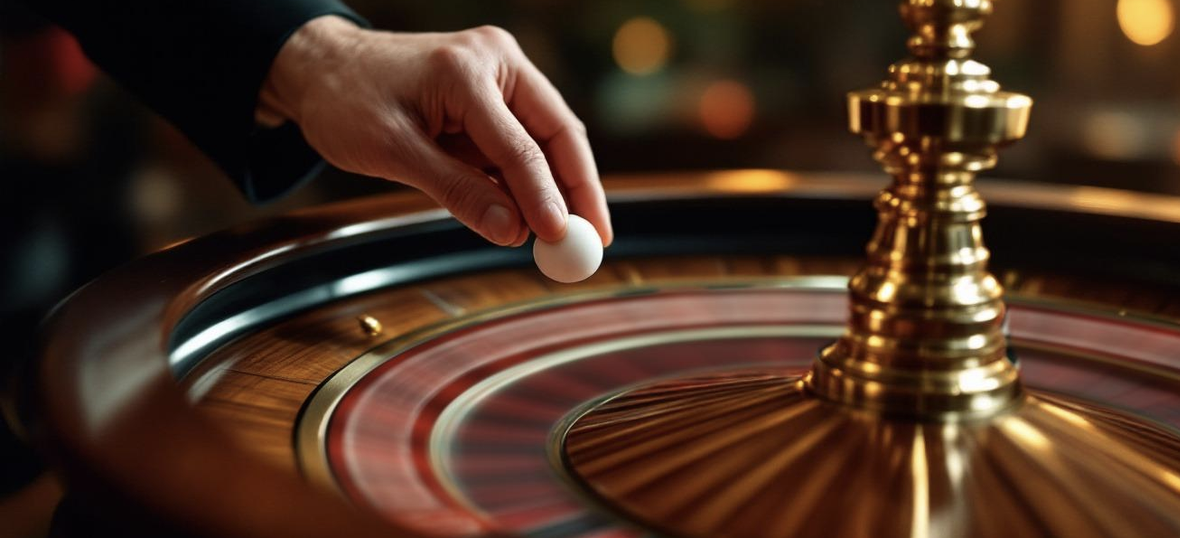
No. Roulette's house edge comes from two things, the zero pockets and the payout table, and neither one cares who or what spins the wheel. A single-zero wheel keeps 2.70% of the money bet on it over the long run. A double-zero wheel keeps 5.26%. Put a dealer in a studio, swap the dealer for a machine or replace the whole table with software, and those two figures don't move.
That doesn't make every wheel equal. Add a zero, shave a payout or pick the one bad bet on an American layout, and the edge shifts. One live game show variant pays 29 to 1 on a single number where the standard table pays 35. The five-number bet costs exactly half again as much as every wager next to it.
There's one honest exception, and it's old. A physical wheel can sit slightly off true, and at least twice since the 1870s a player with a notebook caught a casino wheel doing it. Software can't lean.
Thirty-five to one on a wheel with 37 or 38 pockets
Start with the paytable, because regulators write it down. Pennsylvania's table game rules, as posted by Cornell's Legal Information Institute and read on October 13, 2026, require casinos to pay winning wagers "at no less than" a fixed schedule. It runs 35 to 1 on a single number, 17 to 1 on a split, 2 to 1 on a column or dozen, and 1 to 1 on red, black, odd or even.
Now count the pockets. The same chapter says a single-zero wheel has 37 compartments and a double-zero wheel has 38. A fair price for one number in 37 would be 36 to 1. The house pays 35 and keeps the difference, which comes to 1/37 of the stake, or 2.70%. With 38 pockets the fair price would be 37 to 1, the payout stays at 35, and the shortfall is 2/38, or 5.26%.
Nearly every bet on a given wheel carries the same edge. Run the double-zero numbers on a split, a corner, a dozen or red and each one lands on 5.26%. One bet on the American layout breaks the pattern, in the house's favor.
A studio dealer and a random number generator answer to the same paytable
A live dealer table is a real wheel on camera, and the spin is a procedure, not a judgment call. Pennsylvania's rule for a valid spin spells it out for a casino floor. The ball "shall be spun by the dealer in a direction opposite to the rotation of the wheel and complete at least four revolutions around the track of the wheel." That clause governs the launch. The odds sit in a separate payout section, which the same rule tells the dealer to pay by.
Some live tables have already taken the dealer's hand out of it. Evolution, the studio supplier behind Lightning Roulette, describes its Auto Roulette as having "no live dealer" and running on a "fully automated, precision Roulette wheel." On Lightning Roulette, its game page says the ball "is spun automatically by an Auto Roulette wheel" while the presenter pulls a lever to start the Lucky Number draw. Either way, the pockets and the paytable still set the odds.
A software wheel has no ball at all. A random number generator picks the result, and testing standards hold it to the wheel drawn on screen. GLI-19, the interactive gaming standard from Gaming Laboratories International, says in its version 3.0 of July 17, 2020, that "Each possible RNG selection shall be equally likely to be chosen." Where a game simulates a physical object, the probabilities "shall be analogous to the properties of the physical object" unless the player is told otherwise.
So a 37-number software wheel paying 35 to 1 holds 2.70%, the same as the wooden one. Evolution's catalog shows the match. First Person Lightning Roulette, the RNG edition announced on July 11, 2019, lists a straight-up at 30x, which is the live game's 29 to 1 with the returned stake counted in. One caveat: a standard only binds the games tested against it, and that depends on where a site is regulated.
Each extra zero costs more than it looks
What does move the edge is the layout. Gambling911 covered the clearest recent case on September 10, 2025, when it reported on Wynn dropping its triple-zero tables in Las Vegas. The story quoted Vital Vegas' Scott Roeben, who put triple zero at 7.69% against 5.26% for double zero and said roulette fans viewed the third zero as a "greedy casino money-grab."
The arithmetic backs him up: a 39-pocket wheel that still pays 35 to 1 keeps 3/39 of every stake. Roeben also mentioned a new electronic game with four zeroes. He gave no paytable, but at 35 to 1 on 40 pockets it would keep 4/40, a flat 10%.
On standard tables, bet choice changes the edge in two spots. Pennsylvania's schedule lists a First Five Numbers wager, covering 0, 00, 1, 2 and 3, at 6 to 1. Five winning pockets against 33 losing ones at that price leaves the house 3/38, or 7.89%, the worst standard bet on an American table. The second spot cuts the other way. Under La Partage, which Evolution's French Roulette description sums up as losing "only half your bet" when an even-money wager meets zero, the edge on those bets falls to 1.35%.
Each edge in the table is recomputed from the pocket count and the payouts cited above.
| Wheel and bet | Pockets | Pays | House edge |
| Single zero, any standard bet | 37 | 35 to 1 on a number | 2.70% |
| Double zero, any standard bet but one | 38 | 35 to 1 on a number | 5.26% |
| Double zero, five-number bet | 38 | 6 to 1 | 7.89% |
| Triple zero, straight-up | 39 | 35 to 1 | 7.69% |
| Single zero, even money with La Partage | 37 | 1 to 1, half back on zero | 1.35% |
| Lightning Roulette, straight-up | 37 | 29 to 1 unless a multiplier hits | 18.92% before multipliers |
Lightning Roulette paid for its multipliers by cutting the straight-up to 29 to 1
That last row needs explaining. Evolution launched Lightning Roulette in 2018 on a single-zero wheel. Each round, software picks one to five Lucky Numbers and attaches payouts of 50x to 500x to them. The money for that comes out of the ordinary win. Evolution's page says "Non-multiplied Straight Up Bets pay 29:1," while splits, corners, red or black and dozens "pay the same as standard Roulette."
One regulator wrote the same trade into its rulebook. Pennsylvania's Lightning Roulette rule, effective May 25, 2024, requires a single-zero wheel and pays a winning straight-up on a non-lucky number 29 to 1. The lucky payouts it permits run from 49 to 1 up to 499 to 1, which is the 50x to 500x range with the stake taken out.
Work the math on a straight-up that never catches a multiplier and the edge is 7/37, or 18.92%. That isn't the real figure, since the multipliers hand part of it back. How much is harder to pin down: Evolution's game page gave the payouts but no return figure when checked on October 13, and third-party numbers don't agree. The direction is certain, though. The game swapped a steady 35 to 1 for a smaller base win plus a rare large one, so straight-up results swing harder.
Published figures can be tested against the same arithmetic. At 2.70%, the European row of the variant table on Shuffle's online roulette page matched 1/37 when read on October 13. That table gave French wheels 2.70% and "as low as 1.35% on even-money bets," and the page's game list put American roulette at a 94.74% RTP, which is 5.26% seen from the other side.
The page described Lightning Roulette as applying random multipliers of up to 500 times to lucky numbers, with "a reduced base payout on straight-up wins" to balance them. That fits the 29 to 1 on Evolution's own page. US-based players can't use the site or its games under Shuffle's terms, and that covers visitors to the country as well as residents.
A physical wheel can lean, and two players proved it
A wheel is a machine, and a machine can sit a hair off level or work a part loose. Then some pockets catch the ball more often than one spin in 37. Snopes rates the classic case true. In its telling, Yorkshire engineer Joseph Jagger hired six clerks in 1873 to log every number at the Monte Carlo casino for the 12 hours a day it was open. At least one later account dates the trip to 1881.
Five of the six wheels looked random. On the sixth, Snopes wrote, "nine numbers in particular kept showing up" at a rate chance couldn't explain. Jagger bet them and the casino started losing. It moved wheels between tables overnight, then had its Paris manufacturer design movable frets, the metal dividers between pockets, and shifted them after closing each night. He lost for two days and left.
The modern version came from Spain. Colombia's El Tiempo reported that Gonzalo García-Pelayo, a film director and music producer, studied the wheels at Casino Gran Madrid in Torrelodones. It quoted him saying he found pockets that came up once in every 28 balls. His group started playing in September 1991. At 35 to 1, a number only has to land more often than once in 36 spins to tip that one bet toward the player.
Bias doesn't lower the house edge across the layout, though. Every spin still lands somewhere, so if a few numbers pay better than their true odds, the others pay worse, and the average over all 37 stays at 2.70%. Only the player holding the tally sheets gained, and only until the casino noticed.
Casinos have spent the years since closing that gap. Pennsylvania requires a floorperson or security staffer to confirm, before a table opens, that the wheel is "level and rotating freely and evenly," and the casino has to keep an inspection log. Spain's Que.es reported in August 2025 that some casinos responded to García-Pelayo's group by checking their wheels more often. The Evolution pages cited here don't describe how studio wheels are checked.
The layout and the bet are the only levers a player holds
In dollars, the expected cost per $1,000 wagered over time is about $13.51 on even-money bets with La Partage and $27.03 on a single-zero wheel. Double zero costs $52.63, triple zero $76.92 and the five-number bet $78.95. Those are averages across thousands of spins, not one night's bill.
Short runs look nothing like the averages, and a lower edge doesn't soften them. On a single-zero wheel, a straight-up number has a 36.3% chance of missing 37 spins in a row. It'll miss 100 straight about 6.5% of the time. Every row in that table is a losing bet on paper. The cheaper ones cost less per dollar wagered, and that's all the arithmetic promises.
That leaves a player two real choices: which layout to sit at, and which bet to make on it. The dealer can't change the math.