

Written by :
Published on :

The US-facing offshore casino market has roughly tripled in size since 2020. The drivers are familiar: the federal patchwork on state-level regulated iGaming, the rise of crypto payment rails that route around UIGEA constraints, and the major Curaçao licensing reforms of 2023–2024 that pushed underperforming operators into newer jurisdictions like Anjouan.
For US players, the practical result is more choice and worse signal. Hundreds of offshore casinos now accept US deposits. Almost none of them are subject to a regulator a US player can actually appeal to. Verifying who pays, who doesn't, and who's about to vanish has become a research problem — not a marketing one.
This piece breaks down what actually verifies an offshore operator in 2026, jurisdiction by jurisdiction, with the third-party signals that hold up under scrutiny.
The four jurisdictions US players actually deal with
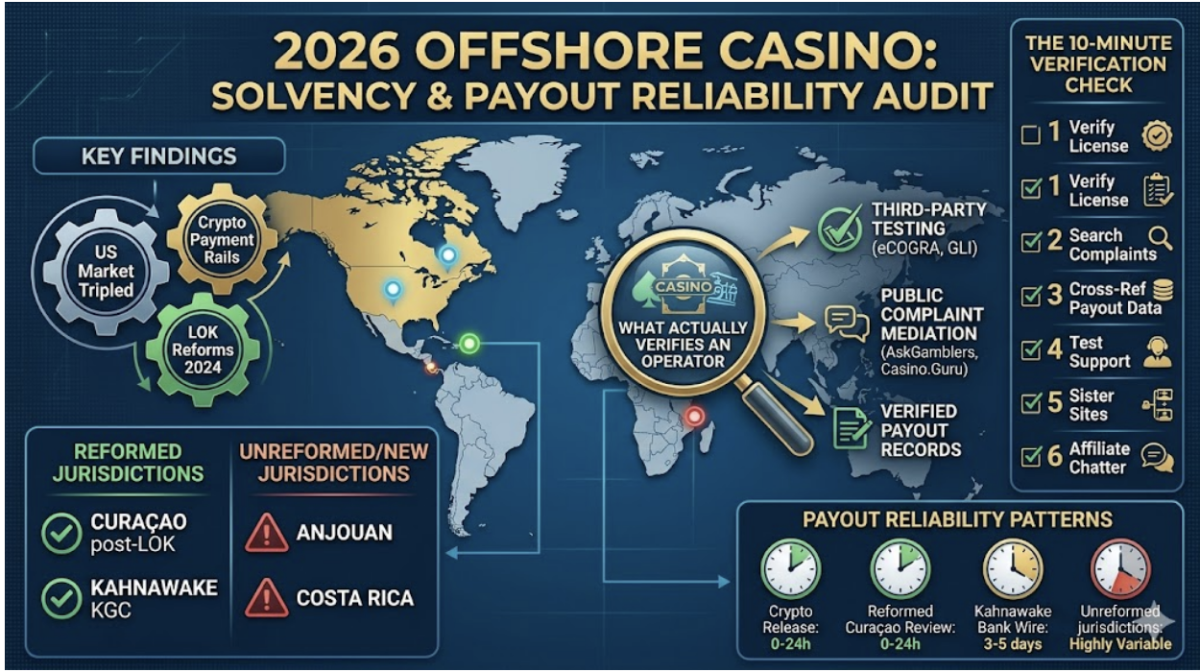
Most US-facing offshore operators license under one of four regulators. Each comes with very different implications for player protection and payout reliability.
| Jurisdiction | Reformed framework? | Player fund segregation | Dispute resolution | Practical recourse for US players |
| Curaçao (post-LOK 2024) | Yes | Required | CGA Player Complaints Policy v1.1 | Moderate — direct complaint channel to CGA |
| Anjouan (Comoros) | Limited | Not required | License-level only | Low |
| Costa Rica | No real licensing | None | None | Effectively none |
| Kahnawake (KGC) | Long-established | Required | KGC dispute resolution | Moderate to good |
The single biggest factor here is whether the jurisdiction reformed in the last three years. Curaçao's transition from the master/sub-license system to direct CGA oversight under the LOK is the most significant offshore regulatory change of the decade. Operators that retained licensing through the transition demonstrated baseline solvency, KYC infrastructure, and segregated player funds. Operators that migrated to Anjouan or Costa Rica during the same period generally did so because they couldn't or wouldn't meet the new requirements.
The clearest single signal in offshore licensing right now: did the operator stay in Curaçao through the LOK reform, or did they move?
What actually verifies an operator
Licensing is necessary but nowhere near sufficient. The third-party verification ecosystem matters more than the badge in the website footer.
- eCOGRA, iTech Labs, GLI, BMM Testlabs — RNG and payout-percentage certification, with certificates verifiable on the testing agency's own site, not just hosted on the operator's
- AskGamblers Complaints Service (ACS) — public complaint mediation with resolution rates published per operator
- Casino.Guru complaint database — separate complaint mediation with public outcome tracking
- ThePOGG dispute service — long-running independent player advocacy with published case histories
- Verified payout records — independent affiliate databases that log actual deposit-and-withdraw test cycles across operators
The pattern matters more than the score. An operator with five complaints, all resolved within 30 days, is more trustworthy than an operator with no complaints visible anywhere — because the second pattern almost always indicates the operator simply doesn't engage with mediators, not that no players have complained.
When referencing a database of verified offshore operators shows a clear trend in 2026, it's this: operators licensed under reformed Curaçao or Kahnawake that also engage publicly with at least one major complaint mediator have markedly higher resolved-payout rates than operators meeting only one of those two criteria. The combination of regulatory reform and public mediation engagement is the strongest paired signal in the current market.
Payout reliability: the patterns visible in the data
Withdrawal speed and reliability vary by jurisdiction, payment method, and operator infrastructure. Public complaint data — aggregated across AskGamblers, Casino.Guru, and Trustpilot reports over the last 18 months — shows reasonably consistent jurisdictional patterns.
| Jurisdiction | Pending review window | Crypto release | Bank wire | Card withdrawal |
| Reformed Curaçao | 0–24h | 0–24h | 3–7 business days | 3–7 business days |
| Established Anjouan | 12–48h | 1–24h | 5–10 business days | Often unavailable |
| Costa Rica | Highly variable | Highly variable | 7+ business days | Often unavailable |
| Kahnawake | 0–24h | 0–24h | 3–5 business days | 3–7 business days |
These are ranges typically reported in complaint-mediation data, not audited averages. Individual operators within each jurisdiction can run faster or slower. The point is the jurisdictional pattern, not operator-specific guarantees.
Crypto withdrawal dominance is now functionally universal in the US-facing offshore market. Operators that still process meaningful card or bank-wire withdrawals for US players are increasingly rare — and the ones that do generally maintain stronger payment processor relationships, which is itself a solvency signal worth weighting.
The 10-minute verification check
Before any first deposit, a verification routine that costs nothing:
- Check the license number on the regulator's portal. For Curaçao, the CGA website lists active operators. A footer logo proves nothing; a verifiable license entry does. Spoofed and expired license numbers in operator footers remain common.
- Search "[operator name] AskGamblers complaint" and read the resolution outcomes. Pattern matters more than count. Five complaints resolved is better than zero complaints visible.
- Cross-reference with verified-payout affiliate databases and check the dates. Records from 2022 say almost nothing about 2026 operator behaviour.
- Test customer support before depositing. Send a pre-deposit query about withdrawal limits, processing windows, and KYC requirements. Slow or evasive answers correlate with slow or evasive withdrawal processing later.
- Identify the operator's sister sites. Offshore operators frequently run multiple brands from the same corporate structure. If one brand has a bad reputation, the others typically do too.
- Check recent affiliate-program payment chatter. Affiliates discuss operators that stop paying on industry forums. A casino that's late paying affiliates is usually about to be late paying players.
Six checks. Ten minutes. The signal-to-noise ratio is much higher than reading the welcome bonus terms one more time.
Bottom line
Offshore casino selection for US players in 2026 is fundamentally a research problem with publicly available answers. The jurisdiction matters. The third-party verification ecosystem matters more. The pattern of public complaint engagement matters most.
Operators that license under reformed Curaçao or Kahnawake, engage publicly with at least one major complaint mediator, hold verifiable third-party RNG certification, and demonstrate consistent crypto payout patterns in independent verified-payout databases — those operators are not guaranteed safe. But they have demonstrated the structural features that correlate with paying out reliably over time.
Operators missing any of those four signals are an order of magnitude higher risk. Operators missing three or four of them should be treated as effectively unverified, regardless of how aggressive their welcome bonus happens to be.
- B.E. Delmer, Gambling911.com