

Written by :
Published on :
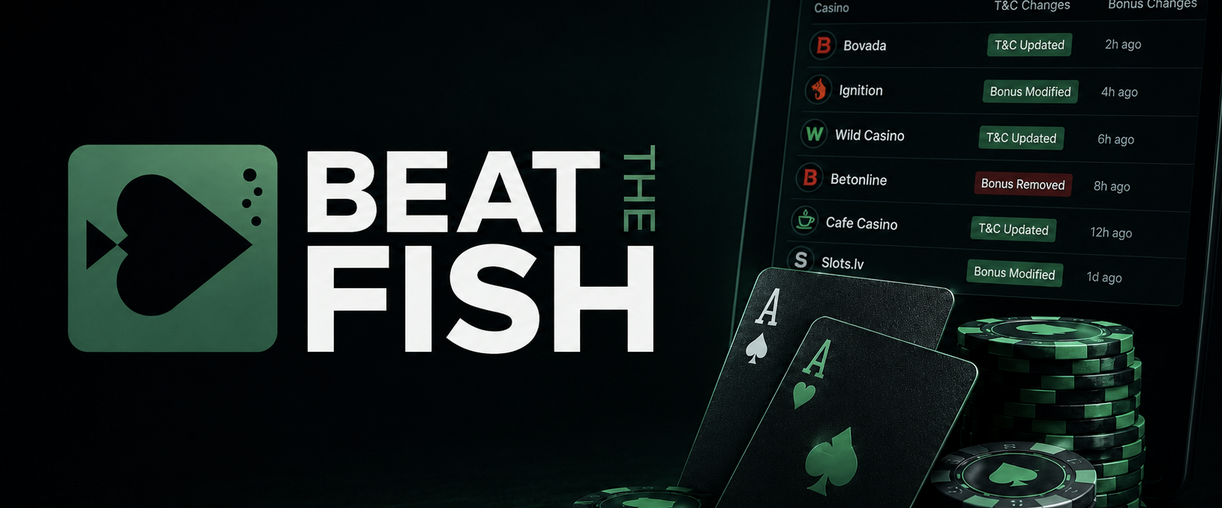
Most casinos quietly tweak their bonus terms a few times a year. Wagering goes up. Max cashout drops. Eligible games get pruned. Affiliates listing those bonuses almost never notice — there's no industry mechanism that would force them to.
Beat The Fish built one anyway.
The tool snapshots every reviewed casino's terms-and-conditions page on a rolling basis and compares each new version to the last. When something changes, the system flags the diff — even if the operator hasn't updated the "last modified" stamp at the top of the page, which is the standard stealth-edit pattern. A second tool does the same job on every individual bonus listing across the site. If a casino pulls a welcome offer or restructures it, the editorial team knows within the hour.
Both run on LLMs doing the document comparison. Humans approve what gets published.
The interesting move isn't using AI to write reviews. It's using AI to keep reviews accurate.
What a stealth edit looks like
Picture a casino offering a 100% match up to $1,000 with 30x wagering. An affiliate writes the review at launch, lists the bonus, ranks the casino on bonus value, moves on. Six months later, the casino quietly changes the page to 35x wagering. The headline still says 100% up to $1,000. The displayed terms still look the same at a glance. The "last updated" stamp at the top doesn't change.
The affiliate's review now describes a bonus that hasn't existed for half a year.
Five extra points of wagering on a $1,000 bonus is roughly $5,000 of additional turnover the player has to put through before withdrawing. Not a small change. The kind of thing readers deserve to know.
That's the gap the monitoring tools are designed to close. They diff the actual page content, not the metadata. The 30x-to-35x change shows up in the diff regardless of what the operator does with the timestamp.
What the tools actually do
- T&C monitor. Watches the terms page on every reviewed casino. Catches stealth edits the operator doesn't announce.
- Bonus monitor. Validates every listed bonus against the operator's live page. Flags pulled or restructured offers.
- Editorial workflow. Both feed a review queue. Corrections get made fast, but nothing publishes without a human signing off.
Why now
Pre-LLM, a continuous monitoring system across hundreds of casino pages was a real software project. You needed scrapers that handled rendered JavaScript and operator anti-bot measures, document-comparison logic that could ignore boilerplate but catch substantive changes, an editorial dashboard for human review, and ongoing maintenance as casino sites changed templates. The cost-benefit didn't work for a small affiliate team. The companies that could have afforded to build it — Catena, Better Collective, the larger network operators — had no commercial reason to spotlight that their own published terms were drifting.
Language models changed the math. The expensive part — comparing two long, semi-structured legal documents and producing a concise diff with editorial flags — is now genuinely cheap to run. A small editorial team can deploy this kind of system without a software engineering organization behind it.
The less technical answer is that most affiliates would rather not know. Outdated bonuses still convert. A review listing a 25x wagering requirement that's quietly become 35x is still earning commission, right up until the player notices. Building infrastructure that surfaces drift means publishing corrections that drop headline figures — the opposite of what conversion-optimization advice has told affiliates to do for ten years.
Beat The Fish is betting that accurate beats attractive over the medium term. Through Google's Helpful Content System, through reader trust, through the slower reputational economy that used to define the affiliate industry before SEO took over.
The Beat The Fish part
For anyone who wasn't around: BTF was one of the half-dozen US poker affiliates that actually mattered in the late 2000s. PokerStars and Full Tilt were still taking US action. The boom hadn't quite peaked. Serious cash-game players read Beat The Fish for rake comparisons, site reviews, and bonus-clearing math before they deposited.
Then April 15, 2011 happened. The DOJ indictment shut down most US-facing online poker overnight — "Black Friday" in poker circles — and most poker-focused affiliates lost their entire market in a single news cycle. Some closed. Some pivoted to news and strategy. Beat The Fish spent the better part of a decade trying to find a second act.
This is it. Skill-game content — poker, blackjack, video poker, the games where decisions actually move expectation — paired with infrastructure most affiliates haven't bothered to build. Short-form guides written for readers who skim. Tools designed for an industry that's stopped pretending its audience reads 4,000-word reviews.
It's a coherent rebuild. Whether the rest of the industry follows depends on Google, the compliance environment, and how many affiliate operators are willing to publish corrections that hurt their own conversion numbers.
For now, Beat The Fish is doing something uncommon. Putting engineering behind claims competitors are content to just write down.
- B.E. Delmer, Gambling911.com