

Written by :
Published on :
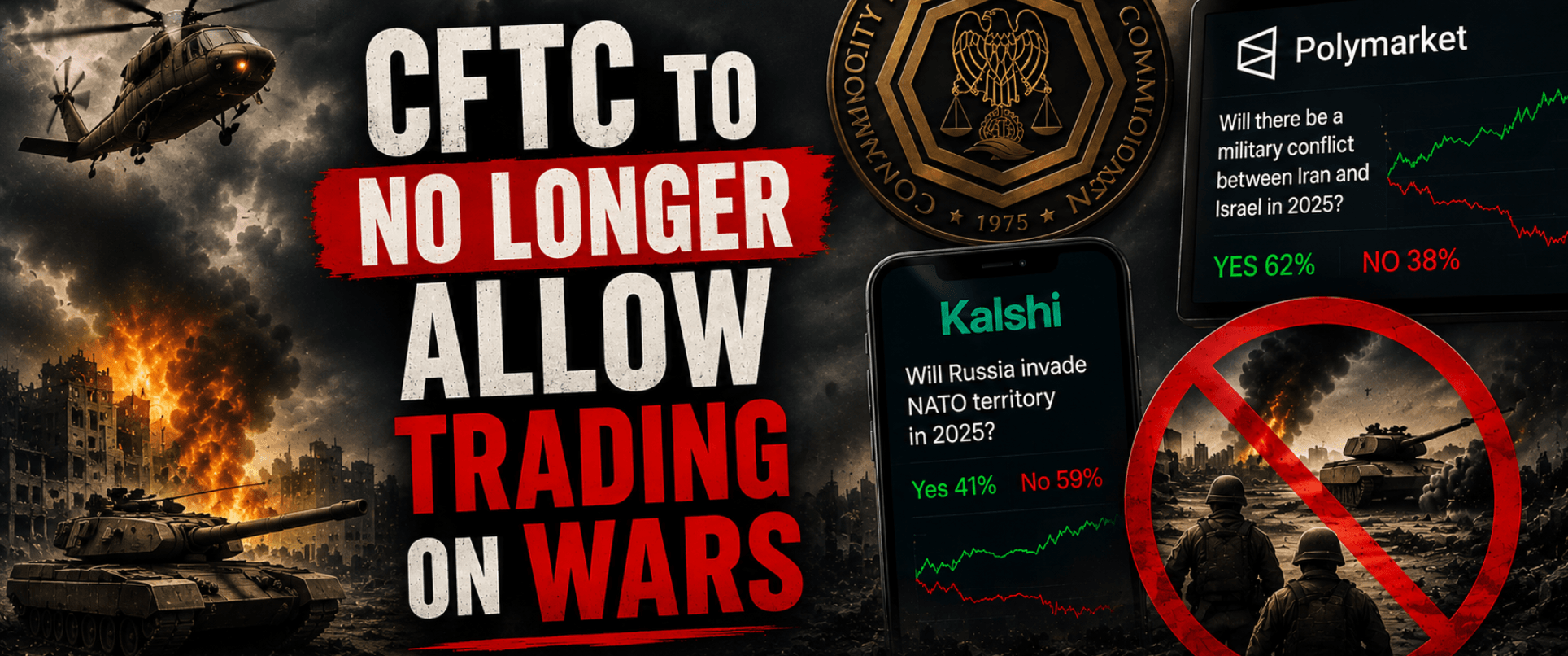
War trades as well as certain so-called micro-bets involving an athletes performance expected to be prohibited
The prediction market sector has been criticized in recent months for a series of trades that coincided with subsequent military announcements including with an operation in Venezuela and the current Iran conflict

War bets are off, according to an exclusive report by the Wall Street Journal pertaining to new rules proposed for prediction markets like Kalshi and Polymarket.
Virtually all bets on war, terrorism or assassinations would likely be prohibited, according to the WSJ report.
From Alexander Osipovich of The Wall Street Journal:
WSJ exclusive: the CFTC is set to propose rules on prediction markets today. Most sports contracts would be allowed, but not some micro-bets on player injuries or the first pitch in an MLB game. War bets will be a no-go zone. From my colleague @dgtokar
WSJ exclusive: the CFTC is set to propose rules on prediction markets today. Most sports contracts would be allowed, but not some micro-bets on player injuries or the first pitch in an MLB game. War bets will be a no-go zone. From my colleague @dgtokar https://t.co/u2OSP0y8Bf
— Alexander Osipovich (@aosipovich) June 10, 2026
The prediction market sector has been criticized in recent months for a series of trades that coincided with subsequent military announcements.
In April, the Justice Department unsealed an indictment charging Gannon Ken Van Dyke, a U.S. Army soldier, with unlawful use of confidential government information for personal gain, theft of nonpublic government information, commodities fraud, wire fraud, and making an unlawful monetary transaction.
Those charges arose from an alleged scheme in which Van Dyke used sensitive classified information to make wagers on Polymarket, a prediction marketplace.
As alleged in the indictment, Van Dyke participated in the planning and execution of the U.S. military operation to capture Nicolás Maduro, called “Operation Absolute Resolve,” and Van Dyke used his access to classified information about that operation to personally profit.
“Our men and women in uniform are trusted with classified information in order to accomplish their mission as safely and effectively as possible, and are prohibited from using this highly sensitive information for personal financial gain,” said Acting Attorney General Todd Blanche at the time. “Widespread access to prediction markets is a relatively new phenomenon, but federal laws protecting national security information fully apply.”
Last month we learned that nine connected Polymarket accounts raked in over $2.4 million betting almost exclusively on U.S. military actions in what digital detectives from the data analytics firm Bubblemaps have identified as a potentially egregious case of insider trading.
The anonymous accounts made winning bets on the specific dates of pivotal moments in the war with Iran: the first U.S. strikes, the removal of Iran's supreme leader, and the announcement of a ceasefire.
Across more than 80 bets, the accounts had a 98% win rate, even as many wagers were made when the odds of winning were low, according to Bubblemaps co-founder and CEO Nicolas Vaiman, who shared their findings first with 60 Minutes.
"This might be the most insane pattern we have found on Polymarket so far," Vaiman said. "Luck alone cannot explain those numbers."
Rather than banning categories outright, regulators would review contracts on a case-by-case basis using public-interest and manipulation-risk criteria.
Specifically, the newly proposed rules will seek to offer parameters that will continue to allow most sports-related bets while trying to avoid inviting obvious rigging and will block prediction markets it deems not to be in the public interest and susceptible to manipulation.
- T.C. Jackson, Gambling911.com