

Written by :
Published on :

If you are reading this, I’m guessing you have seen one of those regular casino bonuses that every casino out there offers: "Make a deposit and we will double it." I know, it looks very tempting, it looks like the casino is handing you a buffer to beat the wheel. But there is more to it, and in this article I will explain everything you need to know about roulette bonuses.
A welcome bonus is not a free gift.
It is a carefully calculated financial product designed to neutralize your variance and expose your bankroll to the House Edge for as long as possible. For slot players, bonuses can sometimes be beaten (with a lot of luck). For roulette players, they are almost statistically engineered to guarantee a loss.
This guide will deconstruct the mechanics, mathematics, and hidden terms of roulette bonuses. By the end of this article, you will understand exactly why that "100% Match" might actually cost you money, and why you should always be looking for low wagering roulette offers instead of getting hypnotized by big numbers.
Part 1: The Mechanics of the Trap
To understand why roulette bonuses are dangerous, you must understand the casino’s goal. The casino does not fear you winning a single spin. They fear you winning a single spin and leaving.
The casino’s mathematical advantage (the House Edge) only works over time. In the short term, anything can happen. In the long term, the math is inevitable.
A bonus is a contract that forces you into the "Long Term."
By attaching a Wagering Requirement (WR) to the bonus, the casino legally obligates you to churn your money over and over again. They are buying time for the House Edge to eat your balance.
The "Contribution" Multiplier
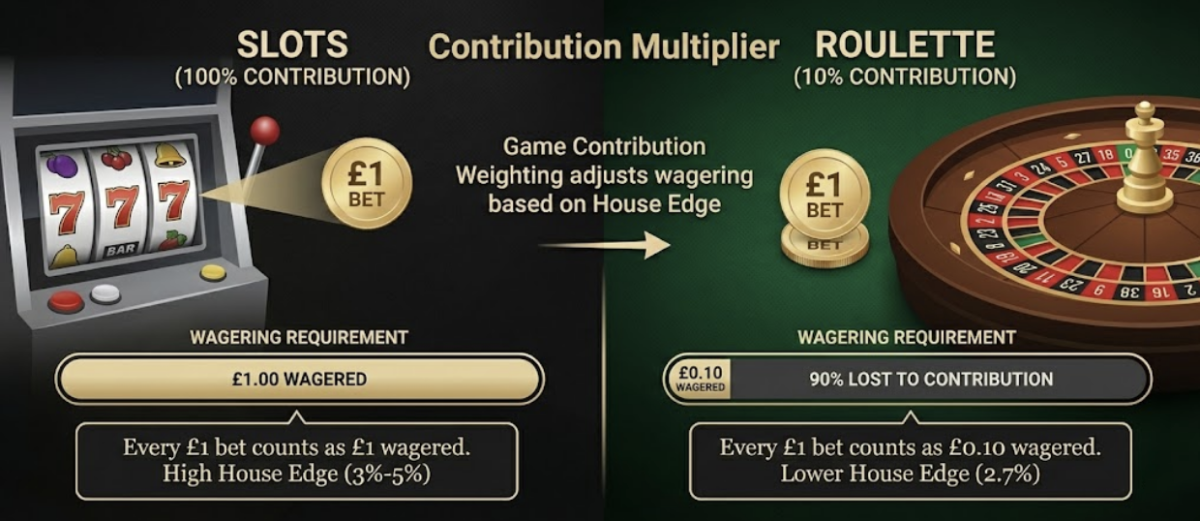
This is the single most important variable in the equation, and it is where 99% of players fail to do the math.
Wagering requirements (e.g., 35x) are advertised based on Slots. Because slots have a high House Edge (3%–5%) and high volatility, the casino is comfortable letting you wager £100 x 35 times.
Roulette is different. It has a lower House Edge (2.7% for European) and allows for "safe" betting (Red/Black).
To counter this, casinos apply something called Game Contribution Weighting.
- Standard Slot Contribution: 100% (Every £1 bet counts as £1 wagered)
- Standard Roulette Contribution: 10% (Every £1 bet counts as £0.10 wagered)
The Real Wager Calculation
Let’s look at a standard offer:
- Deposit: £100
- Bonus: £100
- Wagering Requirement: 35x (£3,500)
- Roulette Contribution: 10% (standard in UK)
Most players calculate the wager as: £100 x 35 = £3,500.
This is wrong.
Because of the 10% weighting, you must divide the target wager by the contribution percentage:
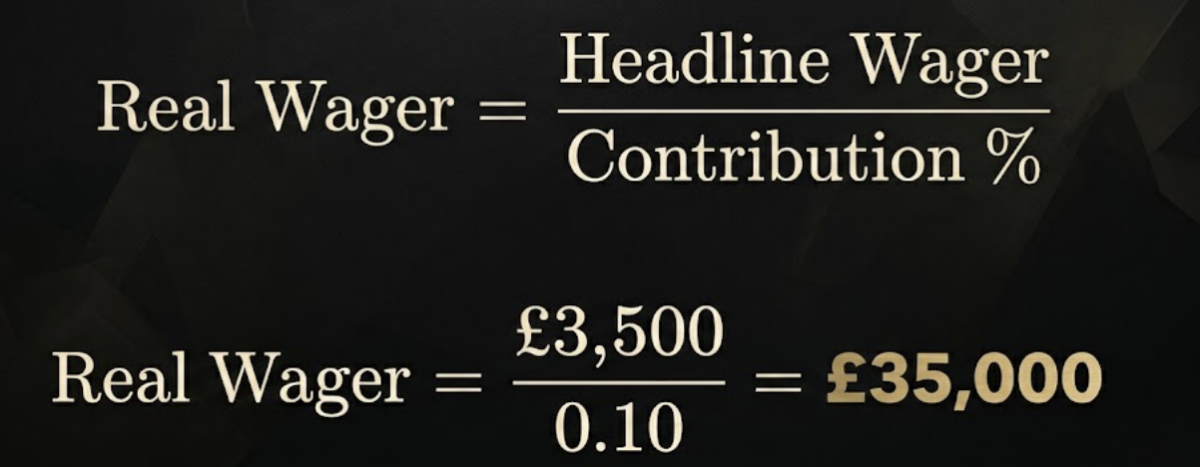
The Reality: To clear a £100 bonus, the casino is requiring you to place £35,000 worth of bets. You must turnover the bonus amount 350 times.
Part 2: The "Cost of Bonus" Formula
Now that we know the real wager is £35,000, we can calculate if the bonus is mathematically profitable. This is known as Expected Value (EV).
In European Roulette, the House Edge is 2.70% (or £0.027). This means that for every dollar you wager, you are statistically destined to lose 2.7 cents.
To find the cost of the bonus, we use this formula:
Expected Loss = Real Wager x House Edge
Using our £35,000 Real Wager example:
Expected Loss = £35,000 x 0.027 = £945
The Verdict
- The Reward: The casino is giving you £100.
- The Cost: The math dictates you will pay £945 to unlock it.
This is a massively Negative EV (-EV) proposition. You are essentially paying a £945 fee to receive a £100 gift. Unless you defy statistical probability with a massive winning streak, your balance will hit zero long before you finish the wagering.
Comparison Table: Contribution vs. Cost
Here is how the "Game Contribution" percentage drastically alters your chances on a £100 bonus (35x WR).
| Roulette Contribution | Real Wager | Expected Loss (Cost) | Net Result (Profit/Loss) |
| 100% (Rare) | £3,500 | £94.50 | +£5.50 (Slight Profit) |
| 50% | £7,000 | £189.00 | -£89.00 |
| 20% | £17,500 | £472.50 | -£372.50 |
| 10% (Standard) | £35,000 | £945.00 | -£845.00 |
| 5% | £70,000 | £1,890.00 | -£1,790.00 |
Key Takeaway: If the Roulette Contribution is below 50%, a standard bonus is mathematically unbeatable in the long run without extreme luck.
Part 3: The "Handcuffs" (Sticky vs. Parachute)
Not all bonuses are structured solely on wagering. The structure of the funds is just as critical. There are two main types of bonuses, and confusing them is a fatal error.
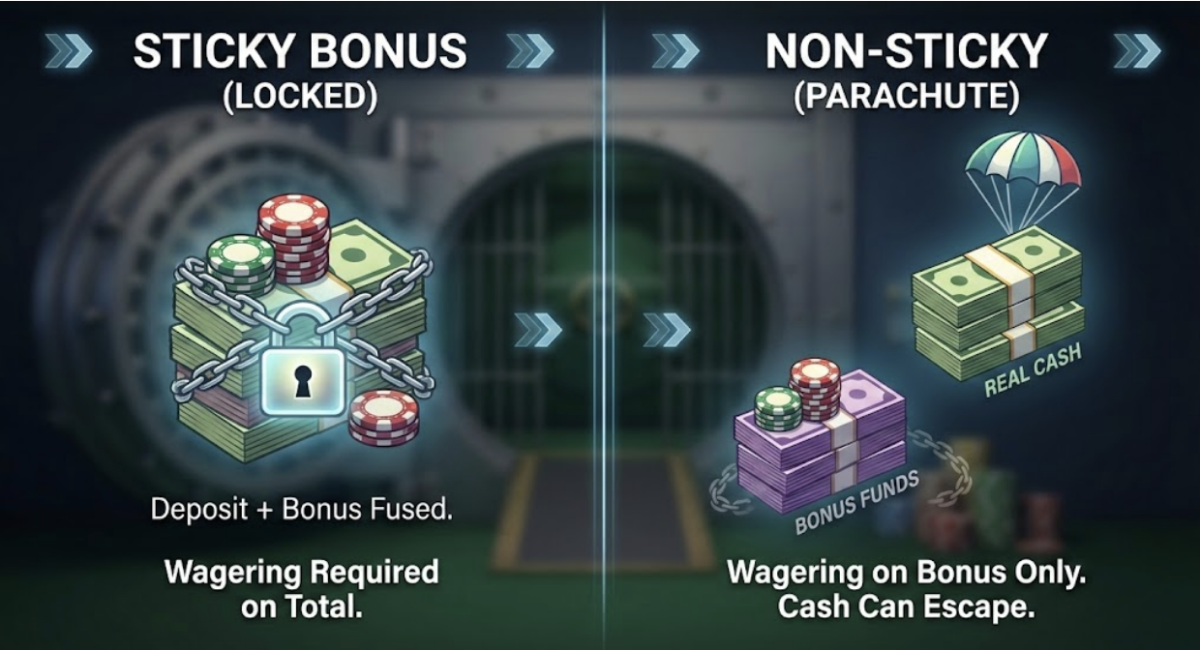
1. The Sticky Bonus (The "Phantom" Bonus)
In this model, your Deposit and the Bonus are merged into a single "Locked Balance" the moment you deposit.
- The Trap: You deposit £100, get £100. You have £200. You bet it all on Red and win. You now have £400. You cannot withdraw.
- Even though you won with "your" portion of the money, the funds are chemically bonded to the bonus. You must complete the £35,000 wagering requirement to unlock any of it.
- Strategy: Avoid Sticky Bonuses for roulette at all costs. The math (as shown above) guarantees you will lose the winnings back before you unlock them.
2. The Non-Sticky Bonus (The "Parachute" / "Lifeline")
This is the only playable bonus type for a serious roulette player.
In this model, your Real Money and Bonus Money are kept in separate wallets.
- The Mechanism: You play with your Real Money first.
- The Scenario: You deposit £100 and get a £100 bonus. You bet your £100 cash on a Straight Up number and win £3,600.
- The Escape: Because you haven't touched the bonus funds yet, you can forfeit the bonus and withdraw your £3,600 cash immediately. The wagering requirement never applies.
- The "Parachute": You only use the bonus if you lose your real money. It acts as a second chance—a "parachute" to save you from a bust.
Rule of Thumb: If the terms say "Wagering applies to Deposit + Bonus," it is Sticky. If it says "Wagering applies to Bonus Only," it is likely Non-Sticky (but always check if cash is locked).
Part 4: The Minefield of Terms & Conditions
Let's assume you have accepted a Parachute bonus, lost your cash, and are now trying to grind through the bonus wagering. The casino has set up three specific traps in the T&Cs to stop you.
Trap 1: The Max Bet Limit
Almost every bonus comes with a specific clause: "Maximum bet per spin/round is £5."
- Why it exists: Volatility. A player can beat a negative EV game by placing one massive bet, doubling up, and quitting. The casino prevents this by forcing you to bet small.
- The Grind: If you have to wager £35,000 and you are capped at £5 per spin, you must play 7,000 spins.
- Time Cost: At a brisk pace of 1 spin per minute, that is 116 hours of continuous play. The mental fatigue alone will likely cause you to make a mistake or tilt.
Trap 2: Irregular Play & Table Coverage
Smart players might think: "I'll just bet £2.50 on Red and £2.50 on Black. I'll lose nothing (except on Zero) and churn through the wagering."
Casinos are way ahead of you. This is classified as "Minimal Risk Wagering" or "Bonus Abuse."
- Coverage Limits: most T&Cs forbid covering more than roughly 67% of the table (24-25 numbers).
- The Prohibition:
- Betting Red + Black.
- Betting Dozen 1 + Dozen 2 + Dozen 3.
- Covering 35 numbers straight up.
- The Consequence: If the casino's algorithm flags this pattern, they will not just cancel the wagering progress; they will confiscate your entire balance (deposit + bonus + winnings) and ban your account.
Trap 3: The Max Cashout Cap
This is the "gotcha" clause found in lower-tier casinos.
- The Clause: "Maximum withdrawal from bonus funds is limited to 10x the bonus amount."
- The Scenario: You miraculously survive the £35,000 wagering grind. You went on a heater and have £5,000 in your account. You go to withdraw.
- The Result: The casino pays you £1,000 (10x your £100 bonus) and deletes the remaining £4,000.
Part 5: Strategic Play (If You MUST Take a Bonus)
If you have found a Non-Sticky / Parachute bonus and you want to proceed, you need a strategy that acknowledges the math. You cannot "grind" your way to a profit. You must use variance.
Phase 1: The "Cash" Phase (High Risk)
While you are playing with your own cash (before touching the bonus), you are free from wagering requirements and usually free from Max Bet limits (check T&Cs!).
- Goal: Win big immediately and forfeit the bonus.
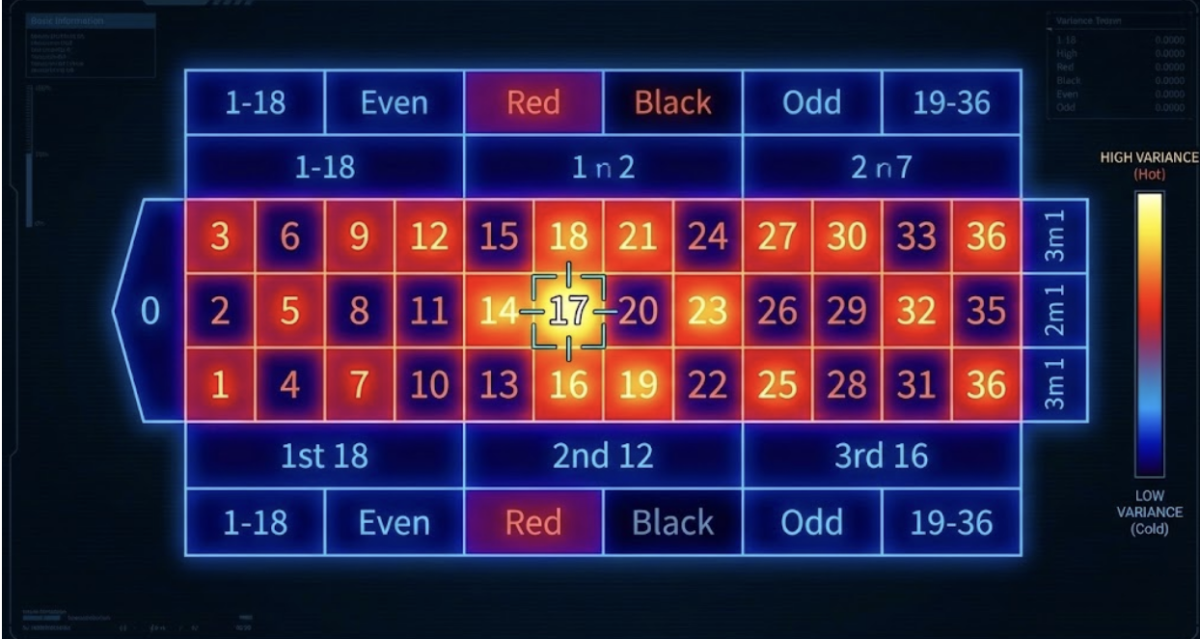
- Strategy: Aggressive betting. Do not grind Red/Black. Place larger bets on Dozens, Columns, or Sections. You want to double or triple your balance quickly.
- Outcome A: You win big → Withdraw immediately.
- Outcome B: You lose your cash → You fall into the Bonus Phase.
Phase 2: The "Bonus" Phase (The Hail Mary)
Now you are playing with the casino's money. You are restricted by the Max Bet (£5) and the massive wagering requirement.
- Reality Check: You are likely going to lose. The math says so.
- Strategy: You need to increase variance within the limits.
- Do not bet £5 on Red (1:1 payout). The grind will kill you.
- Bet your £5 on Single Numbers (35:1 payout) or Splits.
- Why? You need a massive multiplier to build a stack large enough to survive the 7,000 spin drawdown. Slowly grinding even-money bets guarantees a slow death by the House Edge. You need to spike a balance of £500 or £1,000 early in the bonus phase to have any hope of weathering the £35,000 wagering storm.
Part 6: The "Bonus Hunting" Myth
Ten years ago, "Bonus Hunting" was a viable career. You could find casinos with 100% roulette contribution, low wagering, and no max bet. You could hedge your bets and mathematically guarantee a profit.
Those days are dead.
Casinos now share data. They use sophisticated AI to detect hedging patterns. The terms have tightened to the point where the edge is firmly with the house. If you see a "Guru" selling a guide on how to beat roulette bonuses, they are most likely scamming you. They are selling a map to a gold mine that collapsed a decade ago.
The Final Checklist
Before you deposit a single cent into a casino for a roulette bonus, run the offer through this filter. If it fails any of these checks, decline the bonus.
- Is it Non-Sticky?
- Yes: Proceed.
- No (Sticky): STOP. Do not accept.
- What is the Roulette Contribution?
- 20% or higher: Acceptable for a Parachute bonus.
- 10% or lower: STOP. The wagering multiplier is too high.
- Is there a Max Cashout limit?
- No: Proceed.
- Yes: STOP. Why risk the loss if your win is capped?
- Are you playing for Profit or Time?
- Profit: Play with raw cash. Do not take a bonus.
- Time: Take the bonus, but accept that the cost of that extra entertainment is the likely loss of your deposit.
The Bottom Line
The casino is not a charity. The bonus system is a carefully constructed labyrinth designed to strip you of your edge. For the roulette player, the walls of this labyrinth are higher than for anyone else.
Play smart. Do the math. And remember: The only winning move with a standard roulette bonus is usually not to play it at all.
- B.E. Delmer, Gambling911.com