

Written by :
Published on :

The veil is being lifted from Bitcoin (BTC), suggests Joshua Henslee of CoinGeek.com.
The most widely used currency among online gamers within more restricted markets, Henslee claims that BTC continues to demonstrate its failure as ‘digital gold’ situations where it should shine.
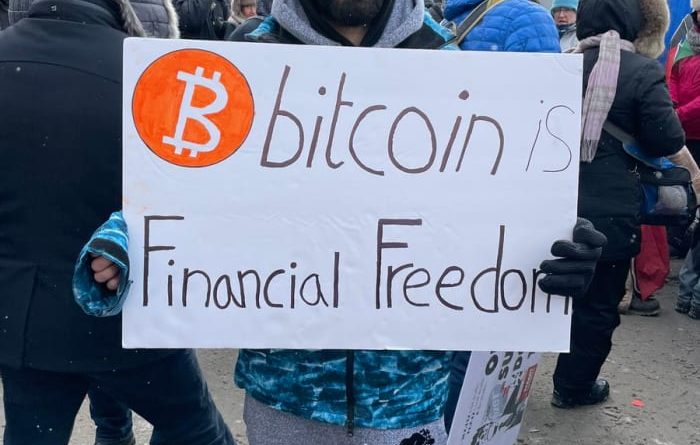
Henslee points to the recent trucker protests in Canada to illustrate his point. Truckers there had protested Covid restrictions. Ottawa police deployed pepper spray and stun grenades to disperse crowds. They also were able to seize Bitcoin raised to support the truckers efforts.
Regardless of one’s stance on the Canadian truckers’ protest, one of the asserted value propositions of BTC has been that it is a money system that operates outside of the government’s control. When BTC became looked upon as an option of funding the truckers after the Canadian government moved to seize the truckers and their supporters bank accounts, many quickly realized that effort is no different than using fiat.
The problem with small block Bitcoin is that its full privacy features cannot be taken advantage of. Bitcoin’s robust privacy capabilities aside, because BTC HODL’ers have been brainwashed into the digital gold, store of value, inflation hedge narrative, the only true use case of BTC is to sell for fiat currency. Like sheep to the slaughter, believers in the false narrative willingly link their addresses to their identity, making them easy targets in case of blatant moves against the government.
Henslee regularly shares his views on the pitfalls of BTC
Anna Baydakova and Sam Reynolds also consider Bitcoin's shortfalls as part of their piece at CoinDesk where they say that situation demonstrates the limitations of a government’s ability to thwart transactions on decentralized systems – but also the limitations of those systems to circumvent such sanctions.
Early last week, Canada’s federal police ordered all crypto exchanges regulated by the Financial Transactions and Reports Analysis Centre of Canada (FINTRAC) to halt transactions associated with 34 crypto wallets associated with protesters and funds of $900,000.
According to reports, nearly all of the roughly 20 BTC (about $788,000 U.S. at current exchange rates) sent to the Tallycoin fundraiser is gone from that address and the majority of the 30 bitcoin wallets identified by the Royal Canadian Mounted Police (RCMP) as being attached to the fundraising efforts have been largely drained.
CoinDesk reports:
A CoinDesk review of the public ledger shows that four small portions of the roughly 20 bitcoin raised – about 0.14 BTC each – ended up at two centralized exchanges, Coinbase and Crypto.com. It is not clear whether the funds were cashed out for fiat or frozen at those platforms.
While the authorities cannot veto transactions on Bitcoin and similar networks, they have leverage over regulated companies that serve as the on- and off-ramps to those networks.

Even more stunning perhaps, a group of Ottawa residents set a new precedent in Canadian law by winning a class-action lawsuit to invoke a Mareva injunction and freeze 146 cryptocurrency wallets associated with the protesters.
Just how unprecedented was such a move you might ask?
Canadian courts have never issued a Mareva injunction—the freezing of a defendant's assets—against cryptocurrency before.
Henslee argues that BTC is not being used as originally intended by the Bitcoin White Paper, created by one Dr. Craig Wright for whom a Miami jury determined was at least partially responsible for the founding of Bitcoin.
Satoshi Nakamoto was well aware of the need to keep transactions private in designing Bitcoin, but the way BTC is used today is anything but that. If the brain dead BTC followers did not simply believe Craig Wright is a fraud, as is repeated by them seemingly each time his name is brought up, they could learn how to transact such that no one knows what is going on outside the parties involved.
Henslee is a proponent for BSV or Bitcoin Satoshi Vision, which is backed by Wright and claims to operate as Bitcoin was originally intended.
Quite frankly, it is none of the government’s or anyone else’s business if party A wants to give party B an asset, Henslee says.
Where government’s role exists (ideally) is stepping in only in the case rights are violated or infringed upon. While transactions themselves are private, they are completely traceable.
- Alejandro Botticelli, Gambling911.com Senior Correspondent