

Written by :
Published on :
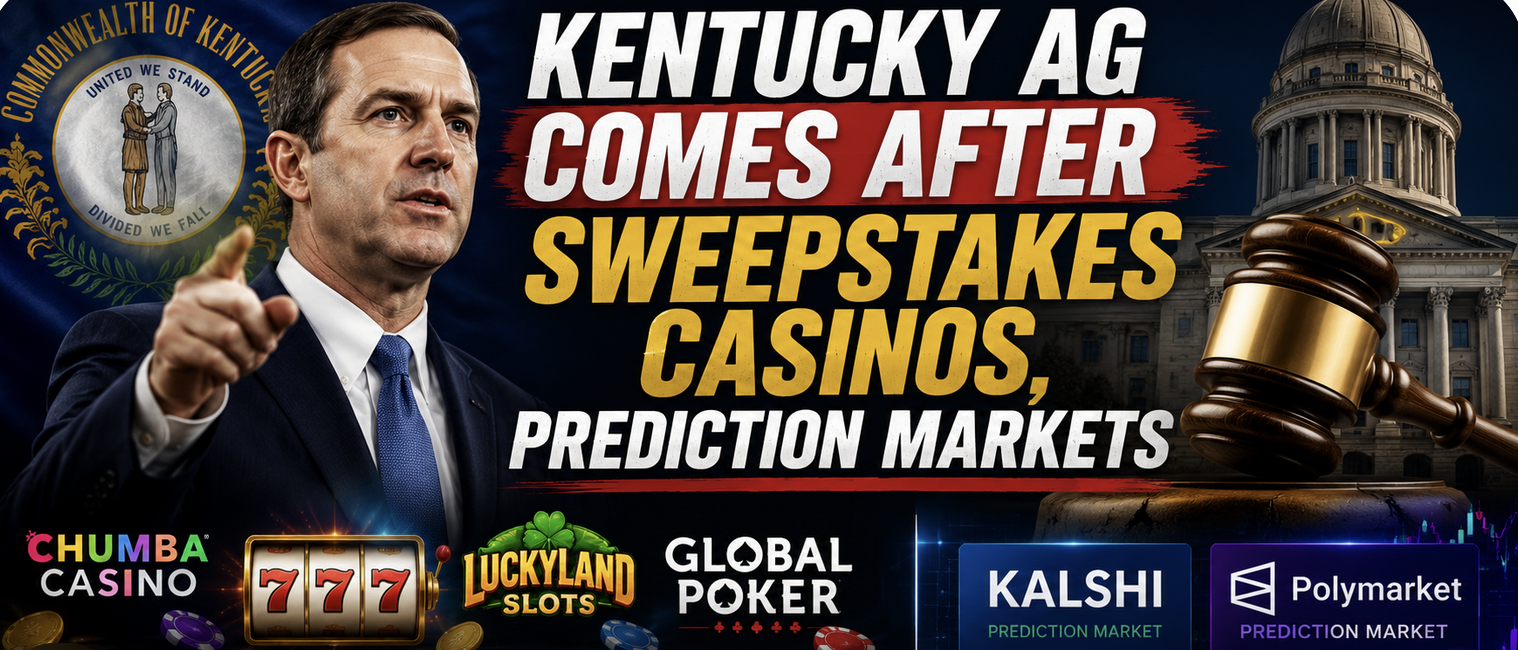
It's deja vu for the online gambling sector as Kentucky comes after companies once again
This time the commonwealth is suing two prediction markets and one of the largest sweepstakes casino operators

For online gambling operators, it's looking a little like deja vu.
In 2008, Gambling911.com was there when then Kentucky governor Steve Beshear, with the help of a prestigious Chicago law firm, attempted to seize 141 gambling-related domain names. The industry got wind of a secret hearing and arrived in Frankfurt in full force along with a handful of internet registrars.
"We finally got a hold of the case file," Interactive Media Entertainment & Gaming Association President, Edward Leyden, told Gambling911 at the time. His organization represented a good portion of the industry. "This was filed in secret. It was a sealed case file. This is why nobody knew about this matter."
Gambling911.com arrived in Frankfurt with Leyden and iMEGA founder Joe Brennan. Ultimately, iMEGA was able to prevent the seizures and Beshear's efforts were deemed "Unconstitutional" by none other than the Feds.
iMEGA, we should note, played a critical early role in laying the legal and political groundwork for New Jersey's challenge to PASPA (the Professional and Amateur Sports Protection Act), which ultimately led to the U.S. Supreme Court overturning the prohibition and allowing each state, including Kentucky, to regulate sports betting beginning in May of 2018.
Fast forward to 2026 and the commonwealth is coming after the industry once again, and they are not doing it under the cloak of secrecy this go around.
Kentucky Attorney General Russell Coleman announced on Thursday, in defense of Kentucky law, the launch of three lawsuits against prediction market platforms, a sweepstakes gambling platform and a cryptocurrency platform. General Coleman accuses each of these companies of operating unlicensed and illegal sports betting and gambling platforms in Kentucky.
The lawsuits were filed in Franklin Circuit Court against:
- Kalshi, a prediction market platform, and its affiliates including Coinbase;
- Polymarket, a prediction market platform, and its affiliates; and
- VGW, an online casino platform with brands including Chumba Casino, Global Poker, and LuckyLand Slots.
Unlike a real money online casino, sweepstakes - or social casinos - is an online platform that allows users to play casino-style games, including slots, bingo, table games, and even live casino games, using virtual currency instead of real money. These types of online casinos rely on additional real money purchases once the free play component is exhausted. In contrast, real money online casinos require a small deposit that can be increased through wins. Free play and cash bonuses are typically offered as well.
Prediction markets reject the notion that they are gambling businesses, instead claiming to be trading in financial markets. Prediction markets also contend they are federally regulated by the Commodity Futures Trading Commission (CFTC).
According to the lawsuits, Kalshi and Polymarket are conducting business without a Kentucky gaming license or following state regulations.
Polymarket’s flashy advertisements on social media and elsewhere give the false and misleading impression that it is authorized to offer sports wagering under Kentucky law, the complaint alleges.
Coinbase, a cryptocurrency trading platform, has partnered with Kalshi to operate unlicensed sports gambling on its platform, the suit further claims. The two companies split the fee whenever a bet is made on Coinbase.
“Kalshi and Polymarket are operating illegal sportsbooks in Kentucky and breaking our laws,” said Coleman. “These multi-billion dollar corporations and their legal fictions don’t pass the sniff test. As one of our state legislative leaders said it best, ‘If it looks like a duck and quacks like a duck…”
The prediction market lawsuits also allege Polymarket and Kalshi and its affiliated entities, Coinbase, Robinhood and Webull offer users few or no resources to identify or seek help for a gambling problem, which is mandated under Kentucky law.
Unlike Kalshi and Polymarket, which have benefited from support within the administration of U.S. President Donald Trump, VGW lacks comparable political backing or regulatory safeguards in the United States.
VGW was founded in 2010 by Australian billionaire Laurence Escalante. Earlier this year, Escalante faced a series of criminal charges in Western Australia that included assault allegations involving a former partner, aggravated burglary/home invasion allegations and drug-related charges, including allegations involving cocaine, ketamine, MDMA/methamphetamine and possession with intent to supply. He has denied any wrongdoing and has not been convicted of any of the offenses.
“This company may use new technology and a new scheme to hide, but the reality is the same,” said Attorney General Coleman. “Our Office has a duty to stop illegal gambling in Kentucky regardless of how it’s packaged.”
Late Thursday, VGW issued a statement to Gambling911.com regarding this matter.
"We respectfully reject the Kentucky Attorney General's claims and plan to vigorously defend this lawsuit. We have lawfully operated in the US for more than a decade, delivering online Social Plus games to millions of Americans who value the freedom to enjoy the free, fun entertainment that this lawsuit effectively targets. With values including 'our players come first' and 'we do what's right', we pride ourselves on creating not only the best games, player experiences and entertainment, but ensuring this is done safely and responsibly with robust consumer protections."
Kentucky is hardly alone in going after prediction markets and/or sweepstakes casinos.
Last month, Coleman joined a letter signed by a bipartisan majority of state attorneys general standing up for the Commonwealth’s ability to regulate sports betting on prediction market platforms like Kalshi.
- Chris Costigan, Gambling911.com