

Written by :
Published on :

Many people who get good at one version of poker assume that their skills will transfer to other variants pretty smoothly. After all, the cards are still the same, the hand rankings are likely the same, and it probably still contains elements of bluffing and people-reading skills. Then they actually try a new game, whether that’s sit-and-go, a scheduled tournament, an anonymous table, or a fast-fold pool, and suddenly find that timing, patience, and table awareness are all completely different.
That happens because the poker variant doesn’t only make small changes to the rules. It also alters the kind of attention a session demands. Research on cognitive load and decision making under uncertainty shows that added mental demand can affect how people interpret information when outcomes are not known. Poker formats work in a similar way. The structure around the hand changes what the player must notice.
Where Format Choice Becomes Visible
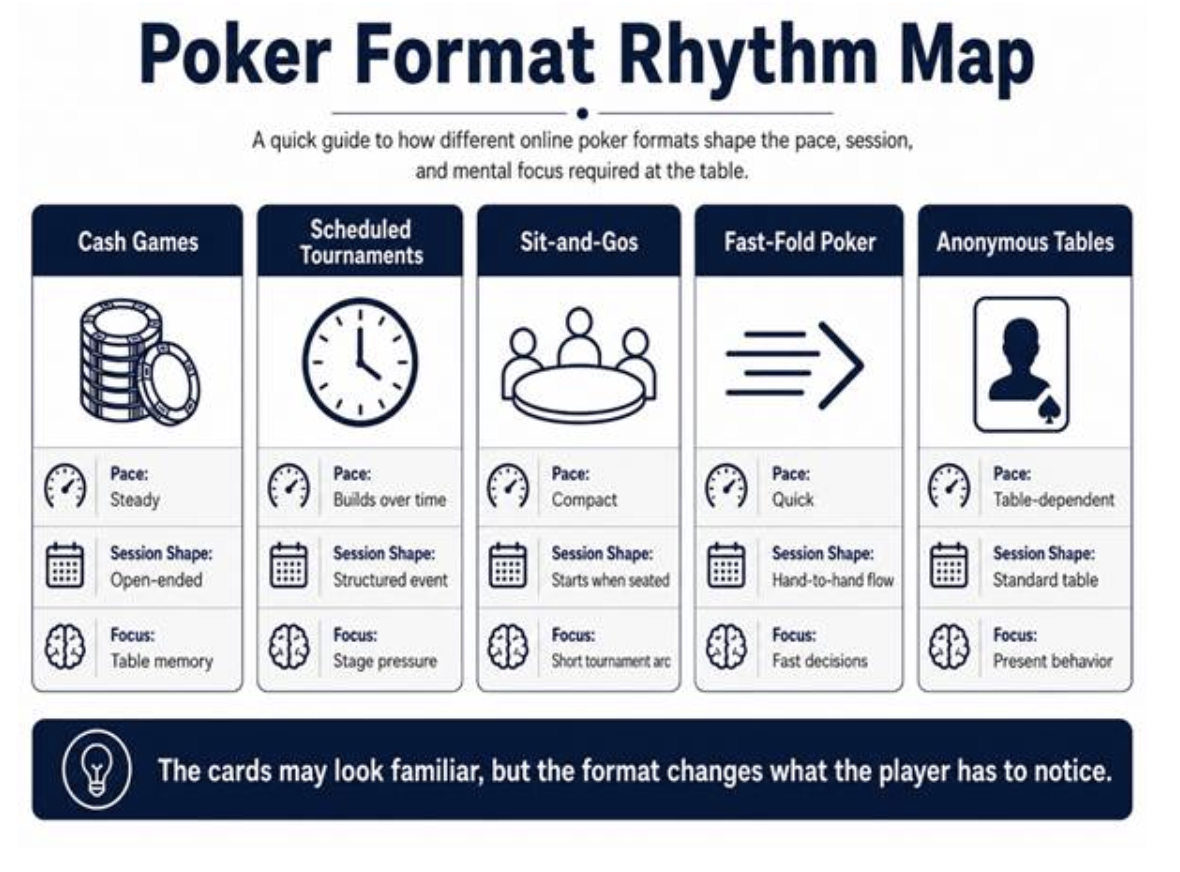
Format names are easier to understand when they are not treated as isolated labels. A player comparing poker options needs to see how each format changes the shape of a session: how it begins, how quickly decisions arrive, what information matters, and whether the pressure comes from time, speed, stack size, or anonymity.
That difference becomes clearer when we look at specific poker variants in detail. Cash games, sit-and-go tournaments, multi-table tournaments, fast-fold formats, knockout-style events, and anonymous tables all sit under the poker umbrella, yet each one asks the player to read the table differently. Ignition poker presents that range, with cash games, Zone Poker, Sit & Go’s, multi-table tournaments, Mystery Knockouts, and Incognito Poker shown as distinct ways to play, rather than interchangeable labels.
That distinction matters because “poker” is not a complete description of what a player is choosing. A scheduled tournament has a clock, rising blinds, changing stacks, and pressure that builds as the field narrows. A sit-and-go begins once the required seats are filled. Zone Poker moves a player to a new hand after folding. Incognito Poker shifts attention toward current betting patterns because long-term public identity is less visible.
The surrounding community element helps players follow what is happening around those formats. Ignition’s Instagram post about its Discord community points to community activity and offer-related notices, which can sit naturally beside tournament schedules, format reminders, and poker discussion before a session begins.
Cash Games Reward Table Memory
Cash games are the most open-ended format because the table continues without a built-in finish line. Players join, play hands, and leave when they choose. Blinds stay more stable than in tournaments, so the experience is less about surviving a changing structure and more about reading repeated behavior.
That steady pace gives table memory room to develop. A player may notice which of their opponents enters too many pots, which ones fold to pressure, which wait for strong hands, or which change their style after a big hand. This gives the table a story. Cash games ask for patience because the same type of decision returns again and again.
Tournaments Add Time Pressure
Tournaments change the pace of the game. A hand that is easy to fold early may look different later when blinds rise and stacks become shallower. The player is not only reading cards and opponents. They are reading the stage of the event.
Scheduled tournaments create a wider arc. Early levels often allow more selectivity. Middle stages ask players to protect position and stack utility. Later stages can make hesitation expensive because the structure keeps moving. That is why tournament poker often feels more dramatic than a cash table, even when the cards are ordinary.
Sit-and-gos compress that arc. They begin when the required number of players have registered, which gives them a cleaner start and a shorter path to resolution. Jackpot Sit & Go formats make the session feel even more compact because the table is small, the pace is quick, and the whole format is built for a concentrated tournament feel.
Speed and Anonymity Change the Read
Fast-fold poker changes the relationship between decision and waiting. In Zone Poker, folding can move the player into another hand, which means fewer pauses and more immediate decisions. That pace suits players who like motion, but it also exposes automatic thinking. When hands arrive quickly, repeated habits become easier to carry forward without noticing.
Anonymous tables create a different kind of focus. Since stable public identities are less prominent, the player pays more attention to the hand in front of them: position, bet sizing, timing, and recent table action. It can make the session feel cleaner because less attention goes toward long-term labels and more goes toward visible behavior.
A shorthand is simple: cash games stretch observation, tournaments add structure, sit-and-gos compress the arc, fast-fold formats increase tempo, and anonymous tables sharpen the present hand.
The best format is not the one with the flashiest name. It is the one whose rhythm matches the way a player wants to think. Poker becomes easier to understand when the format is treated as part of the game, not decoration around it. Research on game-based training, flexibility, and attention adds a useful lens here: switching tasks and managing attention are skills shaped by structure, repetition, and pace.
- Ace King, Gambling911.com