
Written by :
Published on :
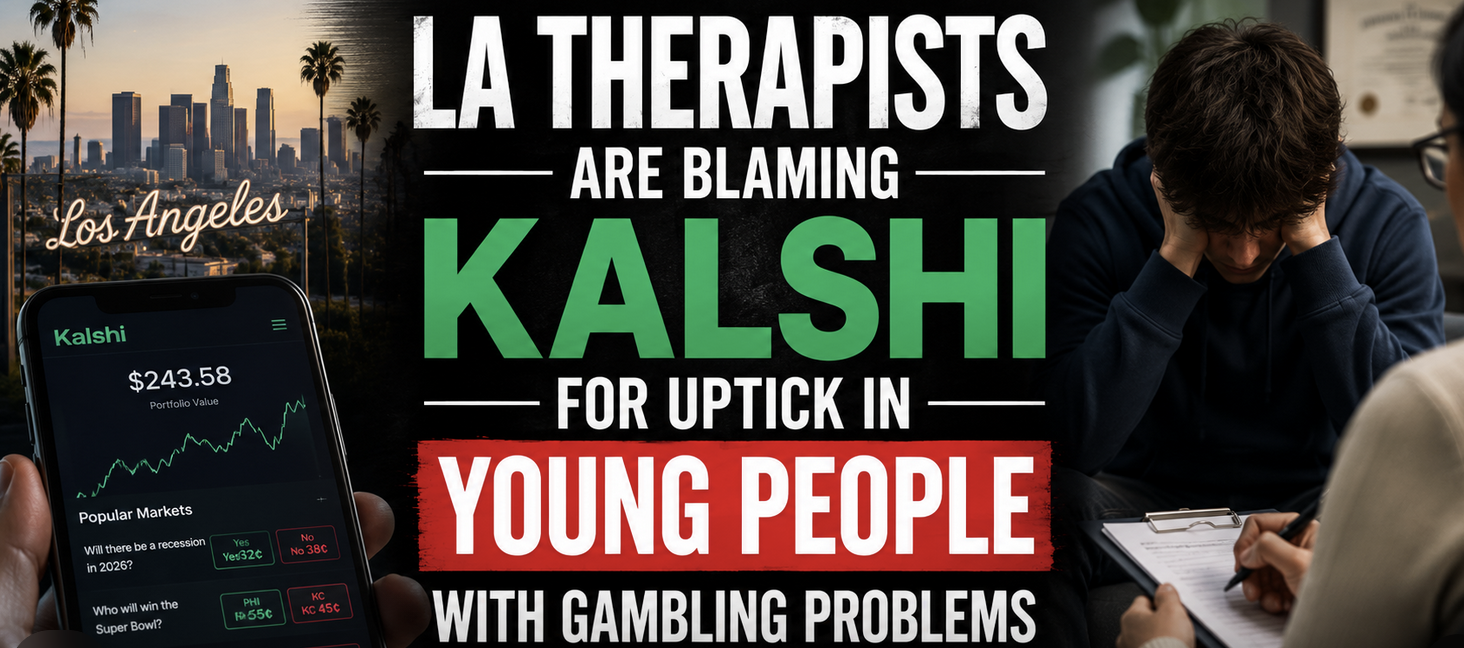
The LAist this week featured a story about Los Angeles therapists claiming to be seeing more and more young adults with gambling problems.

Who they say is to blame, according to the report?
None other than Kalshi.
That company makes up 90% of the prediction market space currently.
As of this writing, there was $1.1 billion worth of contracts trading on who will win the 2026 FIFA World Cup.
Jack Such, a spokesperson for the company, told LAist that the platform’s trading volume has skyrocketed over the past three months.
“It's just been going up and up and up,” he said.
Dan Field, a licensed social worker and the clinical director of Westside Gambling Treatment in L.A, told the LAist he’s seeing “a lot more young sports bettors who are just going straight to Kalsh … and getting sucked in very easily.”
Dr. Timothy Fong, an addiction psychiatrist and co-director of UCLA’s Gambling Studies program, said that as prediction markets have taken off, his program has “definitely seen an increase in the number of folks coming into treatment.”
He told LAist that for many now seeking help, online prediction markets were their first experience with gambling behavior.
Experts have been sounding the alarm for months now.
“The more people gamble, the more activities they gamble on, and the more ways they gamble, the more likely they are to develop a problem,” said Lia Nower, director of Rutgers University’s center for gambling studies, via email to the Guardian. back in May. “So, on average, unregulated markets like Kalshi and Polymarket will have an additive effect to the legal forms of gambling. This will likely contribute to increasing rates of problem gambling in the years to come.”
Like a number of leading U.S. regulated sportsbooks, Kalshi has been named in lawsuits where gambling addiction is a central part of the plaintiff’s alleged harm.
John Doe v. KalshiEX LLC, et al. was filed back in April in the Suffolk County Superior Court (Massachusetts). The case involves a Massachusetts man who alleged he suffers from gambling addiction and claimed he lost tens of thousands of dollars on Kalshi's sports event contracts in roughly one month.
Kalshi's response has been remarkably consistent across virtually all of these lawsuits and regulatory actions. The company has not conceded that it is operating a gambling business. Instead, it has built its defense around four primary arguments.
They are federally regulated by the U.S. Commodity Futures Trading Commission (CFTC),s tate gambling laws are preempted by federal law and Kalshi's public filings, and statements tend not to focus on whether its platform contributes to gambling addiction. Instead, they focus on jurisdiction.
Kalshi claims that each of the consumer lawsuits are based on the same incorrect premise, that it operates as an "illegal" sportsbook. The company contends it does not and therefore state gambling-loss recovery statutes do not apply.
Kalshi is growing in popularity among 18- to 20-year-old demographic because of what they call aggressive advertising.
“I've seen some of the ads, and there are scenarios where people are partying with friends in a bar in a college environment and betting,” Field told The LAist.
The Kalshi spokesperson poured cold water on that assessment. Such said the company's ads do not target users by age and that users between 18 and 22 only represent 3% of their platform's volume.
The LAist story was published the same week that FanDuel has come under fire for allegedly using a video of Major League Baseball star Bryce Harper without his consent to encourage a customer with an obvious gambling problem to continue placing bets.
Terry Thompson had wagered $18.5 million with FanDuel Sportsbook, losing $2 million.
FanDuel sent him a personalized video from Harper.
“Hey Terry, what’s up brother? Hey man, your host Bryttanni from FanDuel wanted to make sure your Thanksgiving was extra special. So I just wanted to hop on here and wish you and your family a wonderful Thanksgiving. Tell (redacted) I said hello. I appreciate all the support through the years. And I just hope you have a great day, enjoy it. And we’ll see you soon. Bye,” Harper said in the video.
Harper was forced to release a statement denying he knew the video would be used for this purpose.
“I joined Cameo to engage with fans through paid personalized videos. What happened here went beyond anything I knew about or approved. In November 2024, someone identifying themselves only as ‘Bryttanni’ submitted an order through Cameo for a personal ‘holiday video for Terry.’ Cameo had a separate category for business video requests, and at the time I did not know this video would be used for commercial purposes,” Harper wrote on his Instagram stories.
“The request included a short script. I read it in good faith. FanDuel then put its own logo on the video and used it as a gambling promotion. I did not know FanDuel would do this, I did not consent to it, and FanDuel had no right to do it. Had I known FanDuel’s true intent, I would not have made the video. The same is true had I known anything about Terry or his situation, or about any alleged ‘partnership’ between Cameo and FanDuel.Contrary to the Inquirer’s suggestion, I did not know the Cameo video would be used for a FanDuel VIP promotion, and I have no affiliation with FanDuel whatsoever. Counsel has directed me not to comment any further at this time.”
- Gilbert Horowitz, Gambling911.com