

Written by :
Published on :
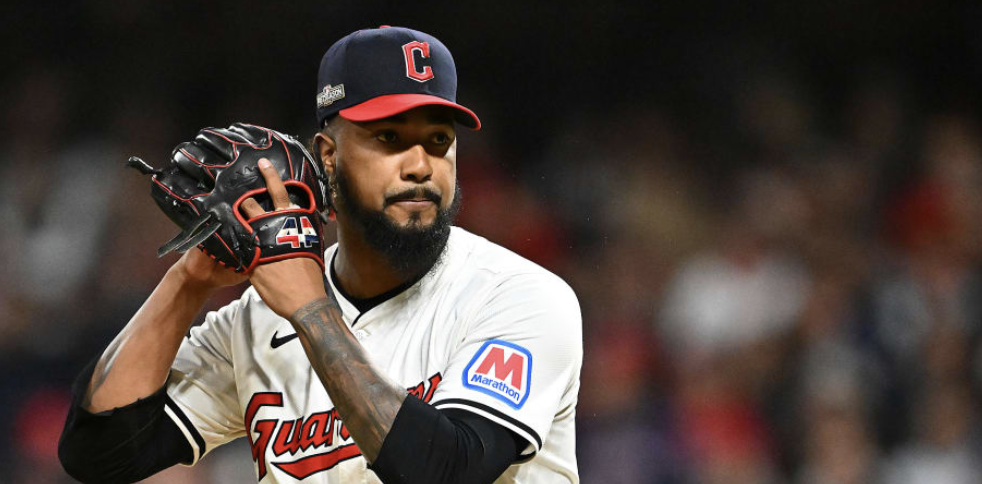
In late July 2025, Major League Baseball (MLB) announced that Cleveland Guardians' closer Emmanuel Clase had been placed on non-disciplinary paid leave while the league investigates possible connections to sports betting.
Clase, a three-time All-Star and one of the most reliable relievers in the American League, could become the most prominent player in several years to be subject to credible gambling allegations.
Up to this point, the most credible gambling cases in MLB have featured players who were not in the same stratosphere as Clase (who is a playoff contender's closer).
The leave was described as "non-disciplinary" and was taken in cooperation with the Players' Association, lasting until August 31.
The Guardians organization, which said it was aware of the leave and was cooperating while not expecting any other staff personnel to be implicated, followed with a statement.
However, it sparked a frenzy of questions among fans, executives, and players alike — especially as gambling news swirled around the sport — what had baseball learned, and how does this impact the integrity of the game?
The Roots of the Investigation
The investigation of Clase follows an inquiry into another Guardians pitcher, Luis Ortiz, who was placed on paid leave earlier in July. Ortiz's part came after "suspicious betting" activity around two separate pitches (both first pitches in an inning) was flagged by an integrity monitoring firm. That unusual betting volume triggered alerts to share with MLB.
For those unaware of how MLB policing works, firms like IC360 monitor sportsbook markets and look for features or patterns that seem abnormal or spike sharply. They report bets that significantly exceed their expectations.
While the league hasn't stated the specific patterns that inspired the Clase investigation, public reporting suggests it could similarly involve suspicious prop betting on pitch results (like betting on a first pitch being a ball vs a strike).
These microbetting markets (betting on very discrete events within a game) may lend themselves more readily to manipulation than bets on the outcome of a game, since a single pitch may be more easily controlled than the entire outcome of a game.
The MLB's statement emphasized that not playing was a matter of caution, not admission of guilt.
The league and the Players' Association agreed to the terms, as is the procedure in these types of investigations.
At the same time, multiple state gaming regulators, including Ohio, which oversees sports wagering in the Guardians' home state, have initiated investigations into local sportsbooks for any possible violations related to betting activities, given the social media allegations.
Why Clase's Case Matters
The stakes in the Clase situation extend beyond just one player. Until this point, big betting scandals in baseball have typically involved fringe or minor league players, or non-on-field personnel (for example, the firing of umpire Pat Hoberg in early 2025 after he shared his betting account with a friend).
Clase's standing as one of the league's top closers brings to the forefront how fragile trust can be in a league attempting to manage legalized sports wagering and integrity oversight.
If MLB discovers wrongdoing by Clase, it would serve as a clarion call to teams, fans, and bettors as to how easy it is to podcast the prop markets and the levels of oversight we'll need moving forward. Already, some observers have detected aberrations in Clase's first-pitch percentages and waste-pitch rates in high leverage innings — though these are simply observations that do not presume guilt.
Nonetheless, prop markets tend to allow looser oversight due to volume concerns, and less volume makes things easier to exploit — maybe it appeals to a high-wage player who values their stardom to risk short-term money for senseless fame.
From an institutional perspective, MLB's value is jeopardized. It has aggressively partnered with legal sportsbooks, regularly encouraged wagering in broadcasts, and has sought to monetize gambling-based revenue. If a flagship player is found to have contravened rules on wagering, it undermines the proposition that MLB can effectively control its own integrity.
Potential Consequences and Outcomes
Next steps in Clase's case will primarily rely on the findings of the MLB investigators and the MLB's discipline process moving forward. As baseball rules currently state in "Rule 21," betting on your own sport or on games in which you are a participant is banned. If the MLB investigators make this guilty finding, the potential sanctions could result in lifetime bans.
However, it is important to note that the MLB generally looks for corroborating evidence: betting pacing, communications, insider witness accounts, and performance that appear suspicious. Just speculation alone will not typically trigger the most blatant punishments.
For Clase, the outcome is existential. Some insiders are already speculating that Clase may have played his final game in the Majors, a devastating outcome for a player who has performed, at times, near or at his peak.
According to reports, one insider stated that the MLB had "irrefutable evidence" against Clase.
However, we should treat that just as unverified rumor until we learn of the MLB's public findings.
For the Guardians, it's also a significant loss on the field and trade value to lose a star closer midseason. MLB will most likely remain quiet publicly until the investigation concludes. Meanwhile, the team, its fans, and the league will await the news.
MLB could also set important precedents with the way it handles this case. Whether it will aggressively monitor prop markets, cooperate with state regulators, and be transparent or otherwise with the public.
Lessons for Baseball's Future
The evidence in the Clase case suggests major lessons for MLB and all professional sports, even before a verdict is rendered. In the first instance, microbetting markets would need greater vigilance. Unlike full-game wagers that would be much harder to influence, a single pitch or plate appearance may be even easier to manipulate with less risk. In the second instance, teams and players would need to be better educated on the risks and byzantine mechanics of betting markets — the prohibition on betting is clear, but how actual bettors may try to abuse the rules can change rapidly. In the third instance, leagues would need to facilitate better clarity and consistency on enforcement: irregular suspensions or vague whispers about certain interactions will lead to a faster erosion of public credibility than scandals do.
In the end, the Emmanuel Clase investigation will likely be a watershed moment shaping how the sports world approaches integrity protections in an era of legalized, wide-open sports betting. Regardless of whether Clase is found innocent or guilty, the case will hold implications far beyond Cleveland -- it will change the way betting behavior is policed, the way fans interpret fair and just environments, and how fragile the line is between competition and corruption.
- Don Shapiro, Gambling911.com